

PostgreSQL or MySQL---which should you choose? This is a really important decision when it comes to relational databases. It's necessary to choose the right database before starting a new project. A team must think about all use cases before finalizing a database. For example, PostgreSQL is better for handling complicated DB calls, and MySQL is better for simpler DB calls.
Before we proceed any further, we have to answer two basic questions.
The first is: what is PostgreSQL? PostgreSQL is an open-source object-relational database system that uses SQL tosafely store and scale complicated data workloads.
And the second is: what is MySQL? MySQL is an open-source relational database management system that organizes data into one or more data tables in which data types may be related to each other. These relations help structure the data.
Overview of PostgreSQL
PostgreSQL is the best database when it comes to processing complex and big queries rapidly. It is extensible because it lets you define data types and index types. Another advantage of PostgreSQL is it is ACID compliant, and it supportsNoSQL as well.

The advantages of PostgreSQL are:
- MVCC support: It has multi-version concurrency control (MVCC) features.
- Frequent updates: It is open source and has wide community support, so it provides frequent updates, like security updates or new features. The latest PostgreSQL update is Version 11.3 as of 13th May 2021.
- Fully customizable: PostgreSQL lets you write and incorporate custom functions made with other programming languages.
- Supports 9 programming languages: C, C++, Go, Java, JavaScript, .Net, Python, R, and Tcl.
- S****upports 6 operating systems: macOS, Solaris, Windows, BSD (FreeBSD, OpenBSD), and Linux
PostgreSQL is one of the best options for open source DB. It's totally free and offers many advanced options. In fact, it is considered to be the most advanced data engine today. This tool is not controlled by an individual or company but rather a community of developers who help us make our job easier and faster.
Overview of MySQL
MySQL is the world's most popular database and a favorite amongst developers. MySQL is fast, reliable, and easy to understand. However, it lacks many of the features that are available in PostgreSQL and MongoDB. It can be useful for giant and scalable web apps. Additionally, MySQL comes with LAMP stack, which is again a good choice for a system.
 View Website
 View Website
 View Website
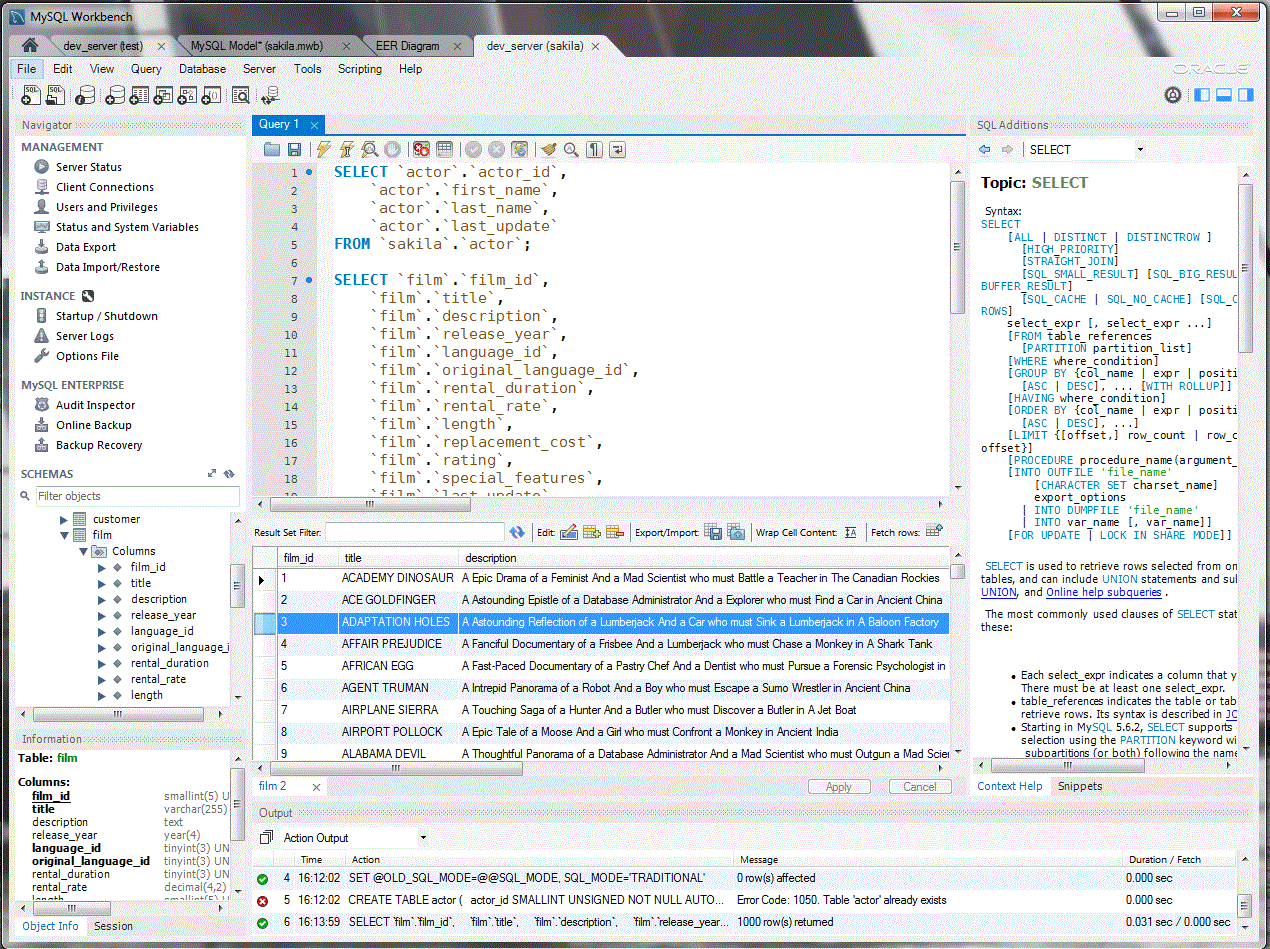
The advantages of MySQL are:
- Maintained by Oracle: Oracle owns MySQL. It has a dedicated dev community that manages updates and bug fixes in MySQL. Oracle also offers a premium paid version with additional features.
- Wide support of the community: Volunteers are available to contribute whenever needed.
- Open-source & free: MySQL is an open-source and free relational database management system.
- Supports 8 programming languages: C, C++, Go, Java, Node.js, Perl, PHP, and R.
- Supports 6 operating systems: Windows, macOS, Linux, Fedora, FreeBSD, Open Source Build.
In short, MySQL is an open, free, and stable database management system that can be used in production systems. It is the basis for lightweight data that can be installed and used on production application servers for large multi-level applications and desktops by developers. It can be installed on all platforms like Windows, Linux, and Mac.
Summary of Differences
The main differences between PostgreSQL and MySQL are:

Which One Should You Choose?
Simply put, if you want to do complex operations and want lots of customized features, then you should go with PostgreSQL. My SQL is simple and easy for most use cases.
Advantages of PostgreSQL over MySQL
- PostgreSQL is an object-relational programming language. It's a good choice when you play with complex data structures.
- It's best for complex queries. Sometimes in a large application, you need to work with complex read-write operations. For such things, PostgreSQL is the best choice.
- Support of NoSQL with other data types: It's a perfect choice if you want to use JSON, XML types of data in your system.
- Multi-version concurrency control (MVCC): Main advantage of MVCC is it lets you read and write simultaneously. This helps queries run faster.
- ACID compliance: PostgreSQL follows all ACID properties, so it's safe at the transaction level as well.
Advantages of MySQL over PostgreSQL
- Scalable and flexible: MySQL supports multiple storage engines and gives the flexibility to import data from various tables.
- Faster for small queries: Yes, MySQL is faster than PostgreSQL for small and simple queries.
- Easy to understand: MySQL is a popular choice for small applications. It has an easy-to-use database and schema.
Conclusion
For more complex databases with higher performance expectations and large amounts of data, PostgreSQL is your best bet. However, if you want something simpler and easier to manage, MySQL will do the job.
Comments (0)