Regression testing tools are the safety net your software can’t afford to skip. As teams deliver features more quickly than ever before, it is critical to ensure that previously developed features continue to function correctly. That’s where regression testing tools come in. These tools automate repetitive tests, catch bugs introduced by code changes, and seamlessly fit into CI/CD pipelines to guard stability without slowing innovation.
Let’s walk through the most effective regression testing tools in 2026 that empower teams to ship with confidence and maintain quality at scale.
What Are Regression Testing Tools?
Regression testing tools are software solutions designed to automate the process of verifying that new code changes do not break existing functionality. These tools execute previously created test cases, compare results across versions, and help teams quickly detect issues introduced during development.
Modern regression testing tools go beyond simple automation. They integrate with CI/CD pipelines, support parallel execution for faster feedback, and in many cases use AI to automatically generate and maintain test cases.
By reducing manual effort and improving test reliability, regression testing plays a critical role in maintaining software quality in fast-paced development environments.
Key Features of Modern Regression Testing Tools
Modern regression testing tools are designed to support fast, reliable, and scalable testing workflows. Before exploring the top tools, it’s important to understand the core features that define an effective regression testing solution:
- Automated test execution across environments
- Seamless integration with CI/CD pipelines
- Parallel test execution for faster feedback
- AI-driven test generation and maintenance
- Cross-browser and cross-platform support
- Detailed reporting and debugging insights
Top Regression Testing Tools of 2026: Rankings & Analysis
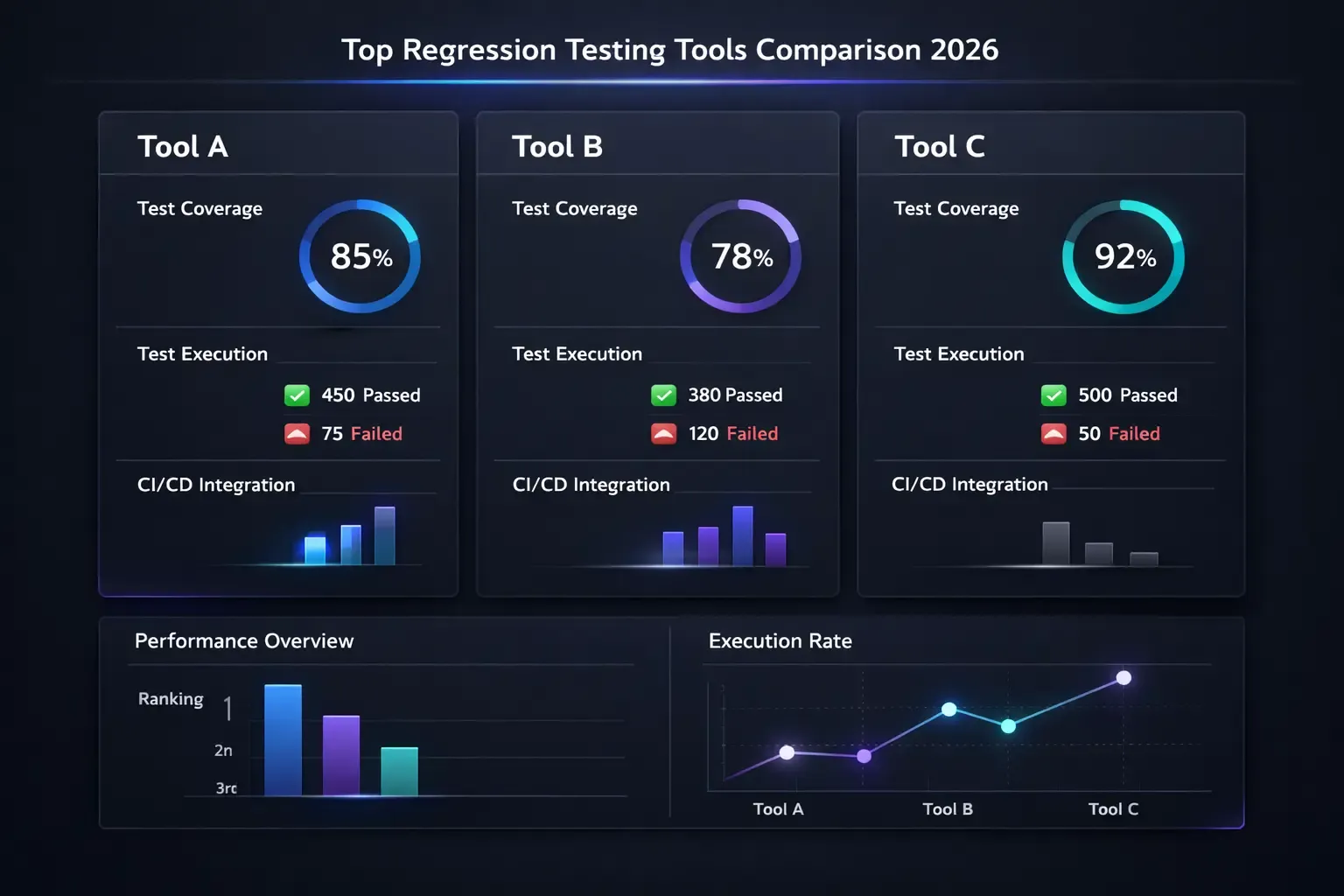
The following section compares the top regression testing tools based on their use case, AI capabilities, ease of adoption, and supported automation types to help you quickly evaluate the right tool for your needs.
Selenium WebDriver
Primary Use Case:
UI regression testing
 View Website
 View Website
 View Website
AI Capabilities:
No
Best Fit For:
Large, complex web applications
Ease of Adoption:
Advanced
Pricing Model:
Free (Open Source)
Automation Type:
UI
Keploy
Primary Use Case:
API regression testing
AI Capabilities:
Yes
Best Fit For:
API-first & backend systems
Ease of Adoption:
Easy
Pricing Model:
Free + Paid
Automation Type:
API
Playwright
Primary Use Case:
Modern web regression
AI Capabilities:
Partial
Best Fit For:
Fast, reliable web apps
Ease of Adoption:
Moderate
Pricing Model:
Free (Open Source)
Automation Type:
UI
TestComplete
Primary Use Case:
Codeless regression automation
AI Capabilities:
Yes
Best Fit For:
QA teams with limited coding
Ease of Adoption:
Easy
Pricing Model:
Paid
Automation Type:
UI / E2E
Katalon Studio
Primary Use Case:
Unified testing platform
AI Capabilities:
Partial
Best Fit For:
Beginner & mid-sized teams
Ease of Adoption:
Easy
Pricing Model:
Free + Paid
Automation Type:
UI / API / E2E
Cypress
Primary Use Case:
Frontend regression testing
AI Capabilities:
No
Best Fit For:
JavaScript-heavy UI testing
Ease of Adoption:
Easy
Pricing Model:
Free (Open Source)
Automation Type:
UI
Appium
Primary Use Case:
Mobile regression testing
AI Capabilities:
No
Best Fit For:
Android & iOS applications
Ease of Adoption:
Moderate
Pricing Model:
Free (Open Source)
Automation Type:
Mobile
How We Ranked These Regression Testing Tools
The criteria for the ranking of the following tools are based on real-world usage factors including:
-
Ease of Use and Learning Curve
-
Test execution speed and reliability
-
CI/CD Integration
-
Automation Intelligence and Maintenance Overhead
-
Integration ecosystem and community support (JIRA, Jenkins, Git, etc.)
Below is a more detailed comparison of the top regression testing tools in 2026, covering multiple layers of testing, including UI, API, and mobile applications.
1. Selenium WebDriver
Selenium remains a gold standard for regression testing, offering unmatched flexibility for advanced testers.
-
Strengths:
-
Extensive browser support ensures compatibility across platforms.
-
Offers flexibility for complex and custom testing needs.
-
-
Weaknesses:
-
Requires programming knowledge, which can pose a challenge for non-technical users.
-
Lacks built-in reporting features, requiring third-party integrations.
-
2. Keploy (AI-Driven Testing Solution)
Keploy is designed for API regression testing. It captures real API calls from your application and automatically turns them into test cases. When new changes are released, it compares responses with previous versions to quickly spot breaking backend changes.
-
Strengths:
-
Automatically generates test cases, reducing manual effort.
-
Tracks API changes and improves regression testing efficiency.
-
-
Weaknesses:
- Still building a strong community and ecosystem compared to older tools like Selenium.
3. Playwright
Playwright, a modern testing framework, excels in testing complex web applications.
-
Strengths:
-
Cross-browser testing works seamlessly out of the box.
-
Supports parallel execution, speeding up test cycles.
-
-
Weaknesses:
- Slightly steeper learning curve for beginners compared to more beginner-friendly tools.
4. TestComplete
TestComplete stands out for its codeless automation capabilities and AI-powered object recognition.
-
Strengths:
-
Perfect for teams with non-technical testers.
-
AI-driven object recognition simplifies creating robust tests.
-
-
Weaknesses:
- High licensing costs may deter smaller teams or startups.
5. Katalon Studio
Katalon Studio is gaining traction for its beginner-friendly interface and robust feature set.
-
Strengths:
-
Combines manual and automated regression testing in one tool.
-
Offers built-in reporting and integrations with popular CI/CD pipelines.
-
-
Weaknesses:
- Limited flexibility for advanced customizations in complex scenarios.
6. Cypress
Cypress remains relevant for frontend regression testing, particularly in JavaScript-based applications.
-
Strengths:
-
Easy to set up and use, making it developer-friendly.
-
Great for testing JavaScript-heavy front-end apps.
-
-
Weaknesses:
-
Lacks multi-browser support (focused on Chrome-based browsers).
-
Struggles with testing complex or large-scale applications.
-
7. Appium
Appium is the go-to tool for mobile regression testing, supporting both iOS and Android platforms.
-
Strengths:
-
Open-source and supports multiple mobile platforms.
-
Versatile for native, hybrid, and mobile web apps.
-
-
Weaknesses:
- Slower test execution times compared to web-focused testing tools.
How to Choose the Right Regression Testing Tool?
Selecting the right regression testing tool depends on your application architecture, team expertise, and automation goals. Instead of choosing the most popular tool, pick the one that fits your workflow and long-term scalability.
Here are some key factors to consider:
1. Application Type
-
Web Applications: Tools such as Selenium WebDriver or Playwright are ideal for complex, multi-browser website testing.
-
API-First or Backend Systems: Keploy is better suited for API regression and backend validation. Mobile Applications: Tools like Appium support both Android and iOS platforms.
2. Team Skill Level
-
Strong Programming Skills: Open-source frameworks like Selenium WebDriver offer flexibility and deep customization.
-
Limited Coding Experience: Tools like TestComplete and Katalon Studio provide codeless or low-code automation.
3. CI/CD and DevOps Integration
If your team deploys very frequently and/or has very short release cycles, you should be looking for a tool that will integrate with your CI/CD environment as well as with your version control systems to provide fast execution times, parallel testing capabilities, and reliable automation test coverage.
4. Maintenance Overhead
Some tools require continuous script updates when UI elements change. Modern automation approaches reduce maintenance effort by minimizing manual script updates and automatically keeping regression coverage in sync with application changes.
5. Budget and Scalability
When choosing a regression testing tool, it is important to consider both the initial cost to set up and ongoing maintenance efforts. Consider both short-term setup costs and long-term maintenance effort.
6. Type of Testing Required
Different tools specialize in different testing layers, so it’s important to choose based on your needs:
- UI testing → Selenium, Cypress, Playwright
- API testing → Keploy
- Mobile testing → Appium
To sum it up, choosing a regression testing tool depends more upon how well a tool aligns with your technology stack, your teams capabilities, and how often you release versus trends in the market. The most suitable regression testing solution should enable you to have confidence in releasing product without introducing delays in the development lifecycle.
Conclusion
The core of software stability is through regression testing, to ensure that newly added features do not disrupt current operations. AI-driven regression testing solutions such as Keploy enable quicker tests through reduced manual intervention, and provide faster feedback allowing developers to execute with conviction. The use of intelligent automation with a knowledge of modern testing practices practices, allows businesses to maintain high-quality software while accelerating innovation. Choosing the right regression testing tool can significantly improve release speed, test coverage, and overall software reliability.
FAQ’s
1. What is regression testing, and why is it important?
Regression testing is a software testing practice that ensures new code changes do not negatively impact the existing functionality of an application. It is crucial because it helps maintain software stability, prevents unexpected bugs, and ensures a seamless user experience after updates or enhancements.
2. How is AI changing the landscape of regression testing?
AI is revolutionizing regression testing by introducing intelligent automation, self-healing tests, and faster test generation. AI-powered tools like Keploy and Testim help reduce human effort, improve test accuracy, and adapt to changing software environments, making testing more efficient.
3. What factors should be considered when selecting a regression testing tool?
When choosing a regression testing tool, consider factors such as ease of use, test execution speed, CI/CD integration, AI-driven features, cross-browser support, and the level of community support. These factors ensure that the tool aligns with your development workflow and testing needs.
4. Which regression testing tool is best for beginners?
For beginners, Katalon Studio and TestComplete offer user-friendly interfaces, codeless automation, and built-in reporting. These tools simplify regression testing for teams with limited programming experience.
5. Why is Keploy ranked among the top regression testing tools of 2026?
Keploy is ranked highly because of its AI-driven approach to automated test case generation, API change tracking, and simplified regression testing. It reduces manual testing effort and enhances efficiency, making it a game-changer in modern software testing.
6. Can regression testing tools be used for API testing?
Yes, many modern regression testing tools support API testing by validating backend behavior and integrations. Tools like Keploy specialize in API regression testing by capturing real traffic and replaying it to detect breaking changes efficiently.
Comments (0)