
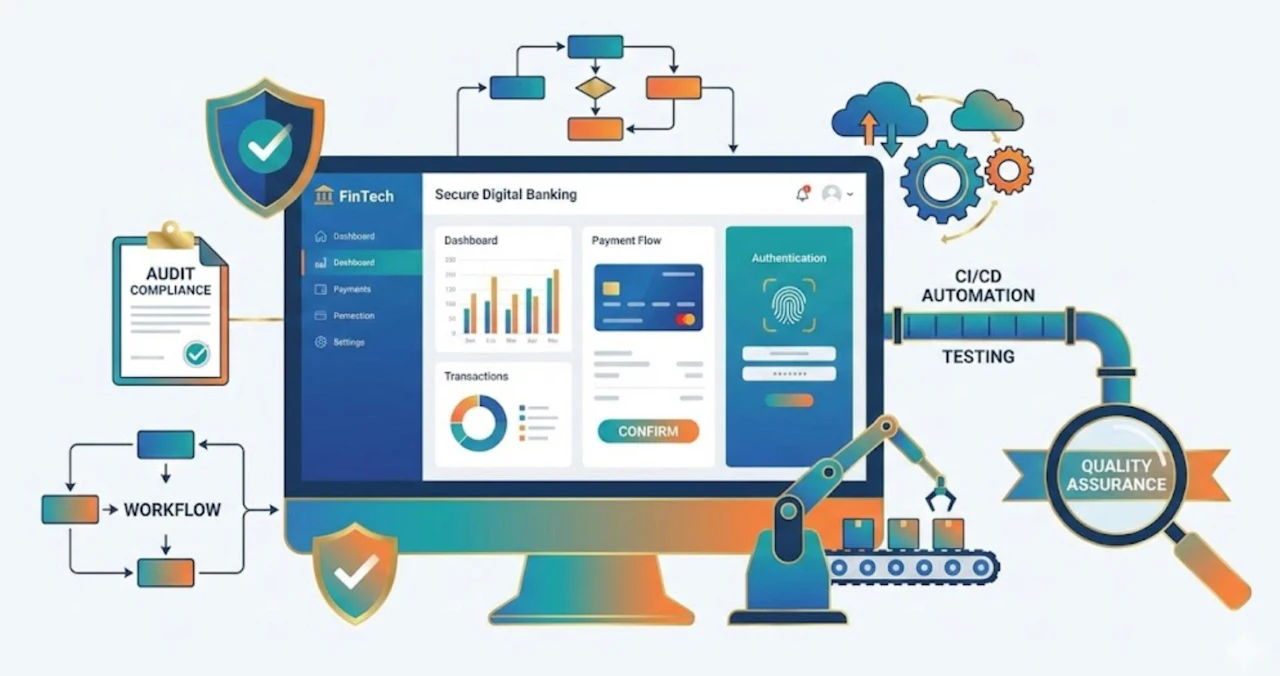
Financial applications operate in an environment defined by strict regulations, high user expectations, and extremely low tolerance for failure. Whether it is a digital banking platform, a payment gateway, an investment app, or an underwriting engine, reliability is not optional. It is essential. Millions of users depend on these systems to stay secure, accurate, and available every day.
To meet this standard, engineering teams must adopt a unified testing approach that addresses compliance, performance, scalability, and the unpredictable nature of real-world financial transactions. This guide explores the testing strategies modern FinTech and banking teams use to protect user trust and ensure regulatory compliance while maintaining rapid development cycles.
The Unique Testing Challenges in FinTech and Banking
Testing financial applications is more complex than testing typical consumer software. The following challenges demand precision and a multi-layered testing strategy.
1. Regulatory compliance
Rules such as PCI DSS, GDPR, RBI guidelines, FFIEC requirements, and other financial regulations mandate strict enforcement of data privacy, auditability, and traceability. Test cases must demonstrate compliance and leave a reliable record.
2. Real-world financial risk
If even one defect slips through, the cost can be significant. Incorrect transaction amounts, failed transfers, misapplied interest calculations, or authentication vulnerabilities can cause financial loss and damage an institution’s reputation.
3. High scalability requirements
FinTech systems often experience unpredictable spikes during market hours, salary days, or major events. Testing for scale, concurrency, and race conditions becomes essential.
4. Complex dependencies
Financial apps integrate with payment networks, credit bureaus, fraud detection engines, core banking systems, and third-party services. Testing needs to simulate these environments accurately.
5. Security as a primary concern
Cyber threats are constant. Testing must cover authentication, authorization, data encryption, session management, and fraud prevention logic.
These challenges require a strategic approach that blends automation, domain knowledge, and realistic validation.
 View Website
 View Website
 View Website
A Multi-Layered Testing Strategy for FinTech Apps
To ensure quality and compliance, FinTech teams rely on several interlinked testing methods.
1. Unit Testing for Financial Logic
Financial calculations and decision engines rely on deterministic rules. Any error in a formula can have cascading effects.
Unit testing ensures:
- Interest and fee calculations are correct
- Business rules behave consistently
- Account and ledger operations remain accurate
- Edge cases like leap years, rounding variations, and rate changes are handled
These tests must be extensive because financial logic leaves no room for interpretation.
2. API Testing Across Distributed Systems
FinTech platforms depend heavily on APIs to communicate with:
- Payment processors
- Internal microservices
- Banking partners
- Risk scoring models
The goal is to validate input and output behavior under normal and stressed conditions. Since these APIs often carry sensitive data, boundary validations and error handling must also be tested thoroughly.
3. Performance and Load Testing at Scale
Financial systems must operate predictably even under severe load. Performance testing verifies:
- Response times
- Throughput
- Resource utilization
- Behavior during spikes
- System recovery under stress
Load-testing tools simulate real transaction patterns to ensure stability before each major release.
4. Security and Penetration Testing
Security testing ensures compliance and resilience. Key areas include:
- Access control testing
- Static and dynamic application security tests
- Vulnerability scanning
- Penetration testing
- Session integrity checks
- Encryption and key management validation
These tests help verify that financial data remains protected end to end.
5. The Role of Comprehensive Workflow Validation
While unit and API testing focuses on isolated components, real user journeys involve multiple systems communicating together. This is where complete workflow validation becomes essential.
Modern teams rely on realistic scenarios that simulate:
- Transaction flows
- Loan approvals
- KYC processes
- Payment settlements
- Investment orders
- Digital onboarding journeys
These workflows must reflect real user behavior. That requires robust end to end testing to ensure the entire system performs reliably across all services and dependencies.
6. Test Data Management for Regulated Environments
Test data must:
- Mask sensitive fields
- Preserve referential integrity
- Represent real-world cases
- Support negative and edge scenarios
- Maintain compliance with privacy rules
Teams often adopt synthetic generation or masked production data depending on regulatory constraints.
7. Continuous Testing Inside CI and CD Pipelines
FinTech teams cannot afford long release cycles. Continuous testing enables faster development while preserving trust. Each deployment must automatically trigger:
- Unit tests
- API tests
- Integration tests
- Regression suites
- Performance baselines for critical APIs
Real-time reporting and alerting allow teams to detect failures early and respond proactively.
Testing Strategies for Compliance-Heavy Financial Systems
Compliance introduces additional requirements that shape the testing strategy.
1. Audit-ready test documentation
Regulators require detailed evidence of:
- What tests were executed
- When they were executed
- What the results were
- How failures were resolved
Automated reporting becomes essential.
2. Traceability from requirement to test
FinTech systems are expected to demonstrate that every functional requirement maps to one or more test cases. This reduces the risk of missing critical scenarios.
3. Immutable logs and test records
Test logs must be tamperproof for review and audit processes.
4. Strong negative testing
Financial systems must gracefully handle:
- Invalid inputs
- Failed transactions
- Suspicious activity
- Fraudulent data
- System outages
Negative testing ensures resilience.
Example Scenarios from Real FinTech Workflows
Scenario 1: Payment Gateway
An online payment gateway must be tested for:
- Multiple payment methods
- Concurrency during peak load
- Fraud detection triggers
- Settlement timing
Any failure directly impacts merchants and consumers.
Scenario 2: Digital Banking Application
Key areas include:
- Authentication flows
- Fund transfers
- Transaction history accuracy
- Notifications and reconciliation
- ATM and card integration
Failures can result in customer trust issues.
Scenario 3: Credit Assessment Engine
Testing must validate:
- Credit scoring rules
- Third-party bureau integrations
- Fraud checks
- Risk model stability
The margin of error must be extremely low.
Common Pitfalls and How to Avoid Them
Pitfall 1: Overlooking Integration Gaps
A function may work independently but break when combined with another service. Avoid this by regularly executing workflow-level tests.
Pitfall 2: Unrealistic Testing Environments
If the staging environment does not mimic production, discrepancies will slip through. Simulated dependencies and accurate datasets are essential.
Pitfall 3: Not Testing for Failure Scenarios
Financial systems must behave predictably even when components fail. Teams must simulate outages, slow networks, and third-party delays.
Pitfall 4: Manual-heavy Testing
Manual workflows slow down releases. Automated tests create consistency and make compliance easier to maintain.
The Future of Testing in FinTech
The financial sector is undergoing rapid digital transformation driven by:
- Cloud adoption
- Real-time payment networks
- AI-driven decision engines
- Open banking APIs
As systems become more interconnected, the need for stronger testing only increases. The shift is moving toward autonomous test generation, self-healing pipelines, and predictive risk scoring models for quality assurance.
The testing strategies used today will determine how quickly and safely FinTech companies can innovate tomorrow.
Conclusion
Trust and compliance form the foundation of every financial application. The right testing strategy ensures that systems are secure, reliable, and aligned with regulatory expectations. By combining strong unit tests, API tests, security validation, performance checks, and realistic workflow coverage, engineering teams can build stable financial products that customers depend on every day.
Comprehensive validation is no longer optional. As financial ecosystems expand, teams must adopt testing practices that safeguard data integrity, minimize risk, and ensure accuracy across the entire user journey.
Comments (0)